Transforming ADHD. Not just managing it.
Attentica is a hybrid, AI-assisted attention training platform for adults with ADHD — built on the peer-reviewed CPAT™ methodology and designed for clinical workflows.

ADHD is widespread — and largely undertreated.
ADHD is characterized by persistent inattention, hyperactivity, and/or impulsivity that interferes with school, work, and relationships. Medication can temporarily reduce symptoms — but it does not build lasting attention skills, and effectiveness varies widely. A durable gap remains in long-term care.
of US children aged 5–17 affected by ADHD
of US adults living with ADHD
people with ADHD in the US population
of adults with ADHD who receive healthcare services
The limits of medication
Stimulants and non-stimulants may reduce symptoms in the moment, but they don't train underlying attention functions. Side effects and variable effectiveness leave patients — and clinicians — without a durable path forward.
The broader attention gap
Beyond formal ADHD diagnoses, broader attention challenges impact an estimated 20–30% of children and adults — creating clinical demand that exceeds what traditional care alone can serve.
A CPAT™-based, hybrid, AI-assisted attention platform.
Attentica combines structured attention training with a real-time AI agent and a therapist-facing analytics layer — one platform for patients, clinicians, and back-office operations.
Structured training tasks
Cognitive-science-grounded CPAT task flows with performance-sensitive measures and progression rules that drive learning.
AI agent
Accompanies, guides, and personalizes the training in real time — creating a closed-loop attention optimization system.
Therapist dashboard
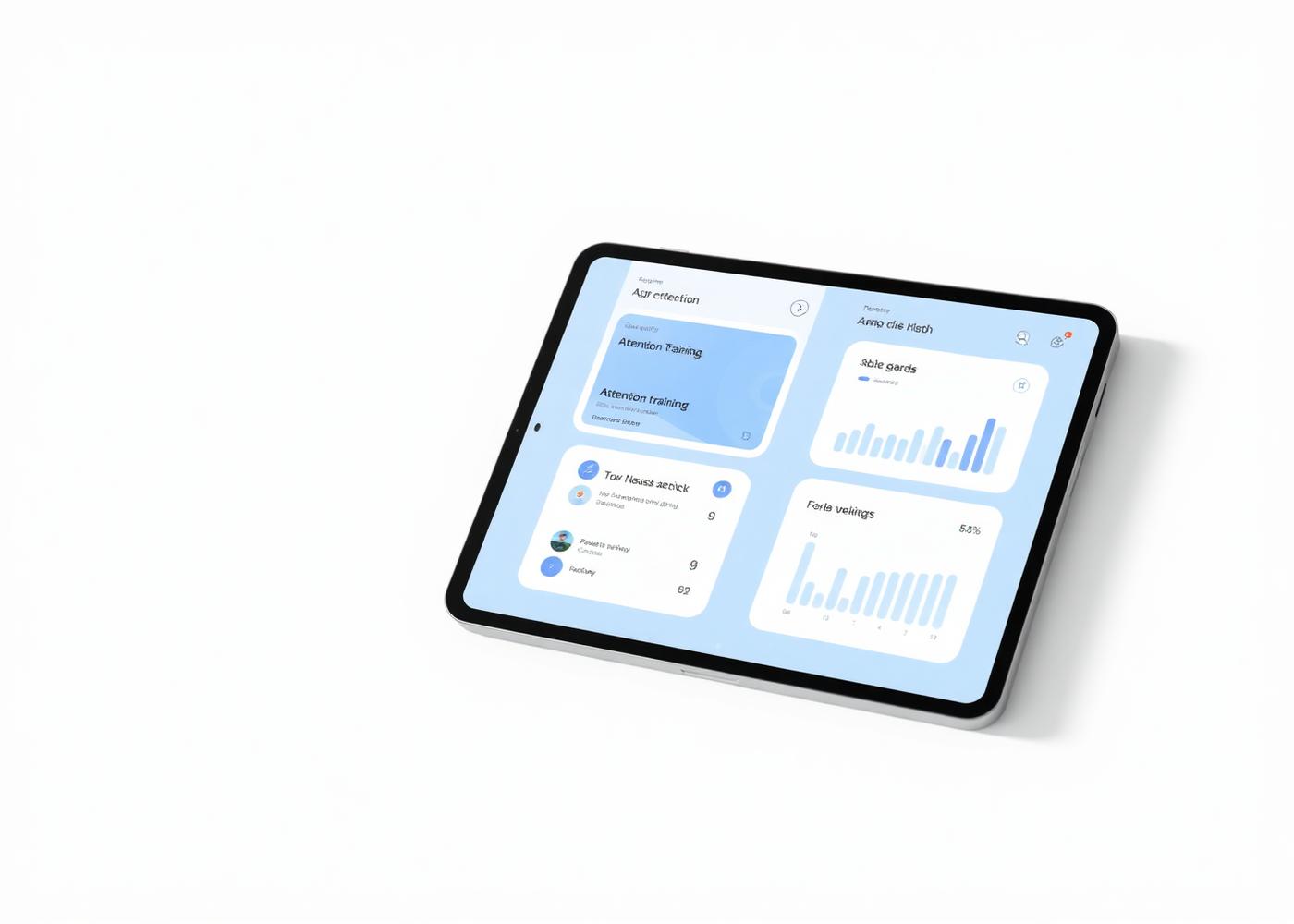
Back-office analytics and AI-informed task-flow personalization surfaces the data clinicians need at a glance.
Compliance & billing
HIPAA-aligned architecture and automated reporting workflows designed to support insurance reimbursement.
Real-time AI adaptation, not batch analysis.
Each session generates structured attention data. Patterns are analyzed across time and users. The AI agent adapts difficulty and guidance in real time, and the data is surfaced directly to the therapist — replacing days of manual clinical tuning.
- User action captured with performance-sensitive measures
- AI analyzes patterns across sessions and cohorts
- Difficulty and guidance adjusted in real time
- Insights delivered to the therapist dashboard
A four-step workflow — clinician-led, AI-assisted.
Patient onboarding
Patients enroll through their clinician and are guided into a personalized training program built around the CPAT framework.
Assessment
Baseline attention performance is captured through structured tasks and performance-sensitive measures.
AI-guided intervention
The AI agent adapts difficulty, sequencing, and guidance session-by-session as a closed-loop optimization system.
Clinical monitoring
The therapist dashboard turns each session into structured, longitudinal signal — supporting review and treatment decisions.
Purpose-built for the way clinics actually work.
Attentica is designed to extend clinical capacity — not replace it. Clinicians stay in the loop, patients get more consistent support, and the platform's reimbursement strategy is aligned with published digital mental health device codes.

Improved patient engagement
An AI companion supports patients between visits, sustaining adherence across the 8-week structured protocol.
Scalable care
Software-only delivery lets a single clinic serve more patients without adding hardware or manual analysis time.
Operational efficiency
Automated data capture and reporting replace hours of manual review with structured, longitudinal signal.
Clinical oversight
The therapist dashboard keeps the clinician in charge, with AI-informed personalization inside their workflow.
Reimbursement-aligned workflow
Attentica's revenue strategy is aligned to the published G0552 (supply and onboarding of a digital mental health device), G0553 (first 20 min/month clinician management), and G0554 (additional 20 min/month) codes — unlocked following FDA submission.
Grounded in peer-reviewed CPAT™ science.
CPAT (Computerized Progressive Attention Training) is a research-proven methodology developed by Prof. Lilach Shalev (Tel Aviv University) and Prof. Carmel Mevorach (University of Birmingham). It's built on a multifaceted model of attention with structured tasks, performance-sensitive measures, and progression rules that drive learning.
Clinically meaningful improvement
Of participants showed meaningful ADHD-related gains in specific studies.
Structured training duration
Effects persisting at follow-up in subsets of participants.
Near-transfer effects
Statistically significant improvement on objective attention measures versus controls.
Far-transfer effects
Evidence of gains in learning and reading-related measures beyond core attention tasks.
Method-specific impact
Effects exceeded those of non-specific computer activity — confirming CPAT's targeted impact on specific attention functions.
University collaborations
Scientific leadership from Tel Aviv University and the University of Birmingham anchors Attentica in international research rigor.
Transfer beyond attention
Published pre- and post-training measures show improvements in math, passage copying, and reading comprehension for the experimental group over controls.
A clear regulatory and reimbursement pathway.
Attentica is preparing for HIPAA compliance and FDA submission as a digital mental health device. Following FDA submission, the platform's revenue strategy is designed to unlock payer coverage under published Medicare G-codes.
Supply & onboarding
Supply and onboarding of a digital mental health device.
Clinician management — first 20 min/month
First 20 minutes of monthly clinician management of the digital therapeutic.
Additional 20 min/month
Additional monthly clinician management time beyond the initial 20 minutes.
Reimbursement under G0552 / G0553 / G0554 becomes accessible following FDA submission. Regulatory status is in preparation and no clearance is claimed.
Where Attentica sits in the ADHD landscape.
| Category | Examples | Limitations | Attentica advantage |
|---|---|---|---|
| Medication | Stimulants / non-stimulants | Side effects, non-durable, no skill training | Skill-building, non-pharmacological |
| Generic brain apps | Games, puzzles | Not theory-driven, weak evidence | CPAT-based, theory-driven |
| Coaching / therapy | Human-led | Expensive, non-scalable | Scalable, digital, data-driven |
| Mindfulness | Apps, courses | Indirect effect on attention | Direct training of attention functions |
| Neurofeedback | Hardware-based | Costly, complex setup, no generalization | Software-only, scalable |
Answers for clinicians and partners.
See Attentica in your clinical workflow.
Tell us a little about your organization. We'll get in touch to schedule a walkthrough of the platform, the science, and how Attentica fits into your care model.